I study how Earth's climate has changed in the past and what that can teach us about the future. My work combines climate records, computer models, and machine learning to better understand patterns such as El Niño, sea ice change, heat waves, and cold spells.
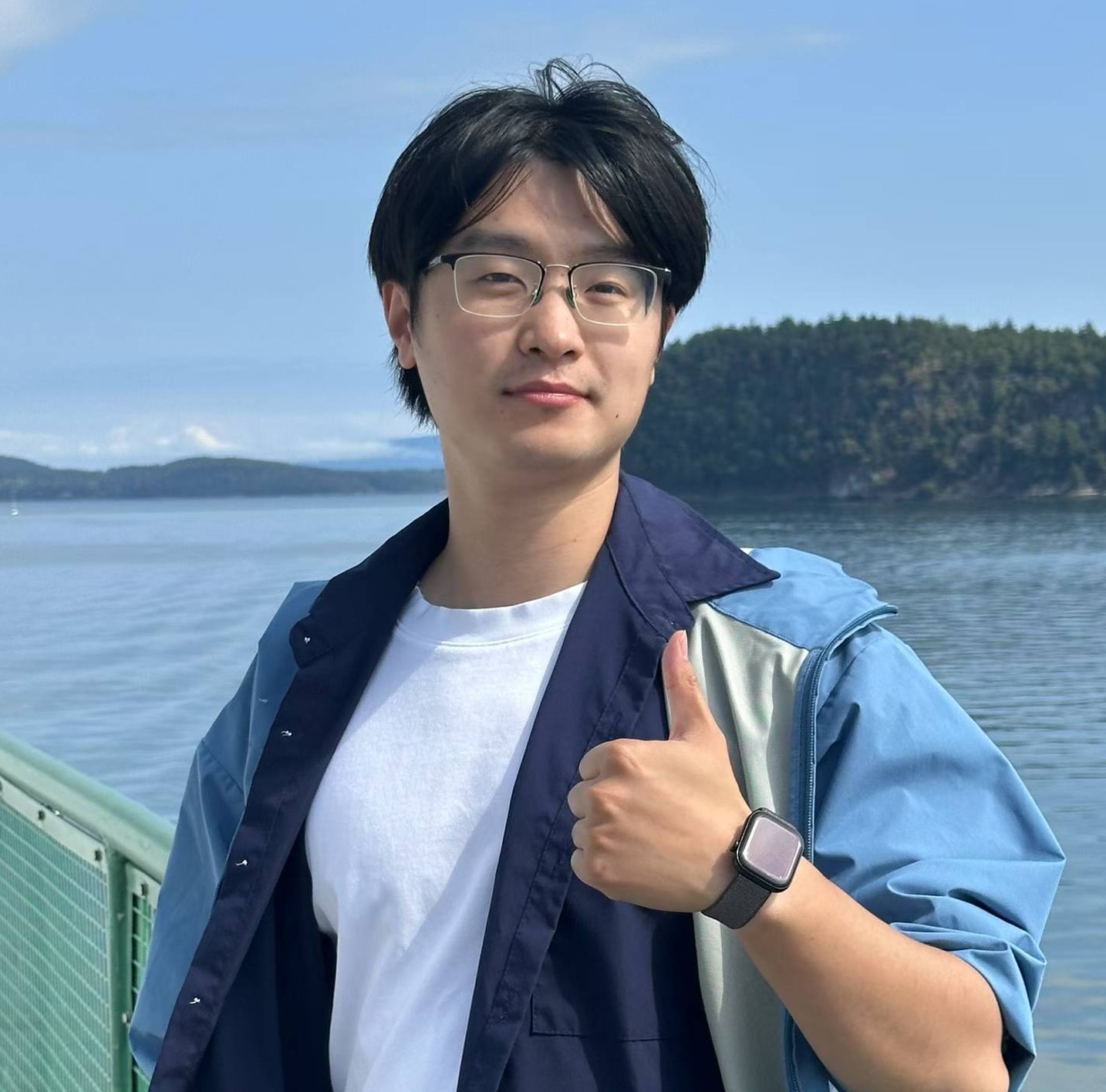
Hi, I am Zilu Meng, a Ph.D. Candidate at the University of Washington, working under the guidance of Prof. Gregory J. Hakim and Prof. Eric J. Steig. Prior to this, I earned my B.S. with honors in Atmospheric Sciences from Nanjing University of Information Science and Technology (NUIST) (Nanjing Institute of Meteorology), where I conducted research on tropical dynamics with Prof. Tim Li.
I am interested in how we can use limited clues from the past, such as tree rings, ice cores, corals, and old observations, to build a clearer picture of Earth's climate history. I also use modern computer models and AI tools to study why climate patterns change, how extreme weather happens, and how our understanding of the past can improve future climate and weather prediction. In my free time, I enjoy playing video games, reading, and hiking.
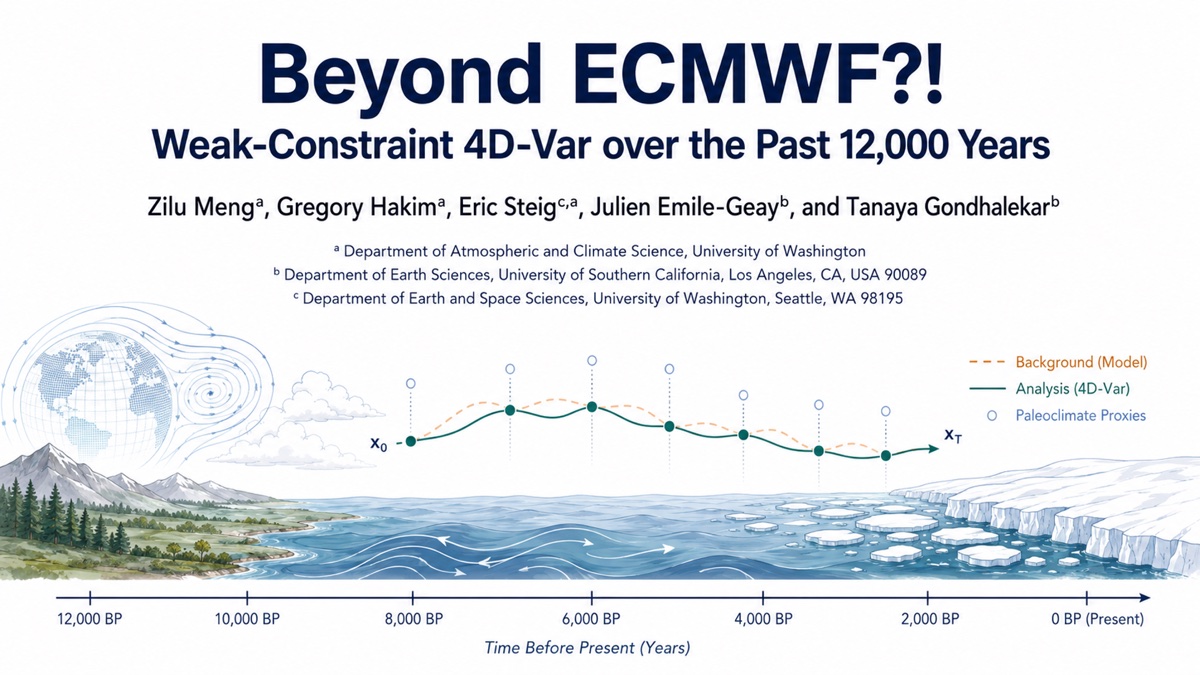
My recent work develops LMR4D, a new way to reconstruct past climate by combining many kinds of climate evidence that record time differently. Tree rings may record year-to-year changes, sediments and ice cores may average over decades, and boreholes can remember centuries of surface temperature change. LMR4D brings these records into one physically guided reconstruction instead of treating them as separate problems.
The framework optimizes a continuous climate history while allowing the model to be imperfect. This makes it possible to combine PAGES2k, Temp12k, and borehole records, and to estimate not only past surface temperature but also slower parts of the climate system such as upper-ocean heat content. The results suggest that recent upper-ocean warming is large compared with late Common Era variability, and show how long-memory records like boreholes can add information that annual proxies alone cannot provide.
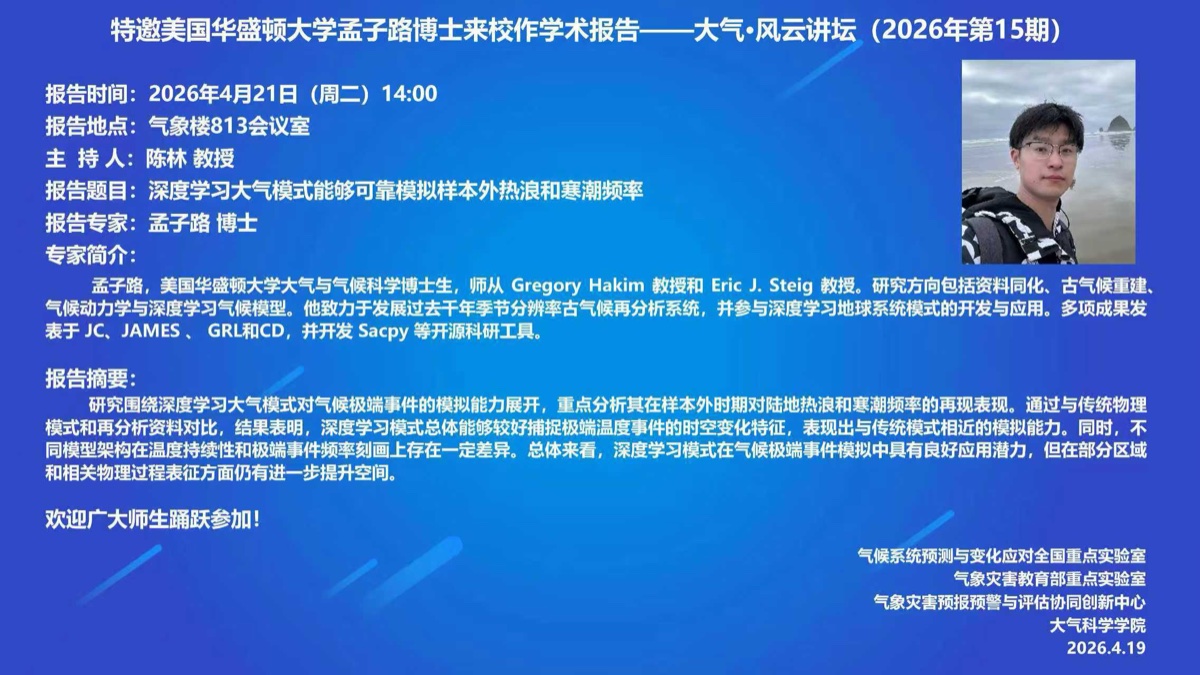
Using Deep Learning based AGCMs (Neural GCM, DLESyM, ACE2), we conducted AMIP-like experiments spanning 1890-2020. We investigate two key questions: (1) Can these models simulate atmospheric conditions outside their training range? (2) How well do these models capture climate sensitivity and physical consistency compared to the real world?
Paleoclimate data assimilation is a powerful technique for reconstructing past climate states before the instrumental era. Instrumental records are relatively short and heavily influenced by anthropogenic forcing, limiting our understanding of natural climate variability. Paleoclimate proxies (e.g., tree rings, ice cores, corals) provide valuable indirect information about past conditions. By integrating these proxies with climate models through data assimilation, we can generate comprehensive reconstructions of past climate fields (temperature, precipitation, etc.) and study phenomena like ENSO, PDO, and AMO over longer timescales.
I am currently developing the first seasonal reanalysis dataset covering the last millennium using an "online" or "cycling" data assimilation approach. This dataset will provide gridded climate fields, enabling detailed studies of past climate variability and change. For instance, the comparison (shown right) of the Nino3.4 Index from our reanalysis with the HadISST dataset highlights the potential to accurately capture ENSO behavior over the millennium. This allows for comparisons between past and present climate dynamics.
A manuscript detailing this work has been published in the Journal of Climate (Meng et al., 2025, [PDF]).
Dataset: LMR Seasonal Data Portal
"Online" data assimilation (DA) is used to generate a seasonal-resolution reanalysis dataset over the last millennium by combining forecasts from an ocean–atmosphere–sea-ice coupled linear inverse model with climate proxy records. Instrumental verification reveals that this reconstruction achieves the highest correlation skill, while using fewer proxies, in surface temperature reconstructions compared to other paleo-DA products, particularly during boreal winter when proxy data are scarce. Reconstructed ocean and sea-ice variables also have high correlation with instrumental and satellite datasets. Verification against independent proxy records shows that reconstruction skill is robust throughout the last millennium. Analysis of the results reveals that the method effectively captures the seasonal evolution and amplitude of El Niño events, seasonal temperature trends that are consistent with orbital forcing over the last millennium, and polar-amplified cooling in the transition from the Medieval Climate Anomaly to the Little Ice Age.
Key Features:
Related Publication: Meng et al. (2025), Journal of Climate
Summary of completed reviews.