arXiv preprint · September 2026 · v2

LMR 4dvar

Coupled multiscale paleoclimate reconstruction with four-dimensional variational data assimilation

Climate history, fitted together. LMR4D-Var combines seasonal records, long-term averages, and borehole memory within one evolving atmosphere–ocean–sea ice trajectory.

Zilu Meng, Gregory J. Hakim, Julien Emile-Geay, Tanaya Gondhalekar & Eric J. Steig
University of Washington · University of Southern California

Preprint abstract

The paper in the authors’ words

Paleoclimate archives extend climate knowledge beyond the instrumental era, registering different seasons, variables, time averages, and memory lengths. A longstanding problem is to integrate these heterogeneous sources of information within a unified methodology. Here we present a new data-assimilation framework, Last Millennium Reanalysis 4D-Var (LMR4D-Var), which reconstructs climate trajectories from these heterogeneous datasets while balancing errors in the model, observations, and initial conditions. We compare results using LMR4D-Var to assimilate proxies from PAGES2k, Temp12k, and borehole temperature profiles without treating them as instantaneous equivalents. Instrumental verification shows that LMR4D-Var achieves the highest skill compared with previous reconstructions. Borehole assimilation preserves skill against withheld annually resolved records, increases agreement between reconstructed 300–2000-m ocean heat content (OHC) and independent estimates, and yields a cooler reconstructed Little Ice Age ocean. Modern 130-year trends in both reconstructed OHC layers significantly exceed their pre-1870 Common Era trend distributions. Results for Temp12k demonstrate assimilation of decadal-to-millennial records and the potential for Holocene and deeper-time applications with suitable emulators.

From the v2 preprint PDF, dated 9 September 2026. Version record · Original PDF.
Main reconstruction
500 BCE–2000 CE
Analysis time step
4 seasons / year
Coupled climate state
6 climate variables
Climate-model priors
5 model-specific priors

The research question

How can records with different memories share one climate history?

A tree ring can constrain one season. A sediment record can constrain an average over centuries. A borehole profile contains a diffused memory of earlier surface temperatures. Each record describes a different part of the same history.

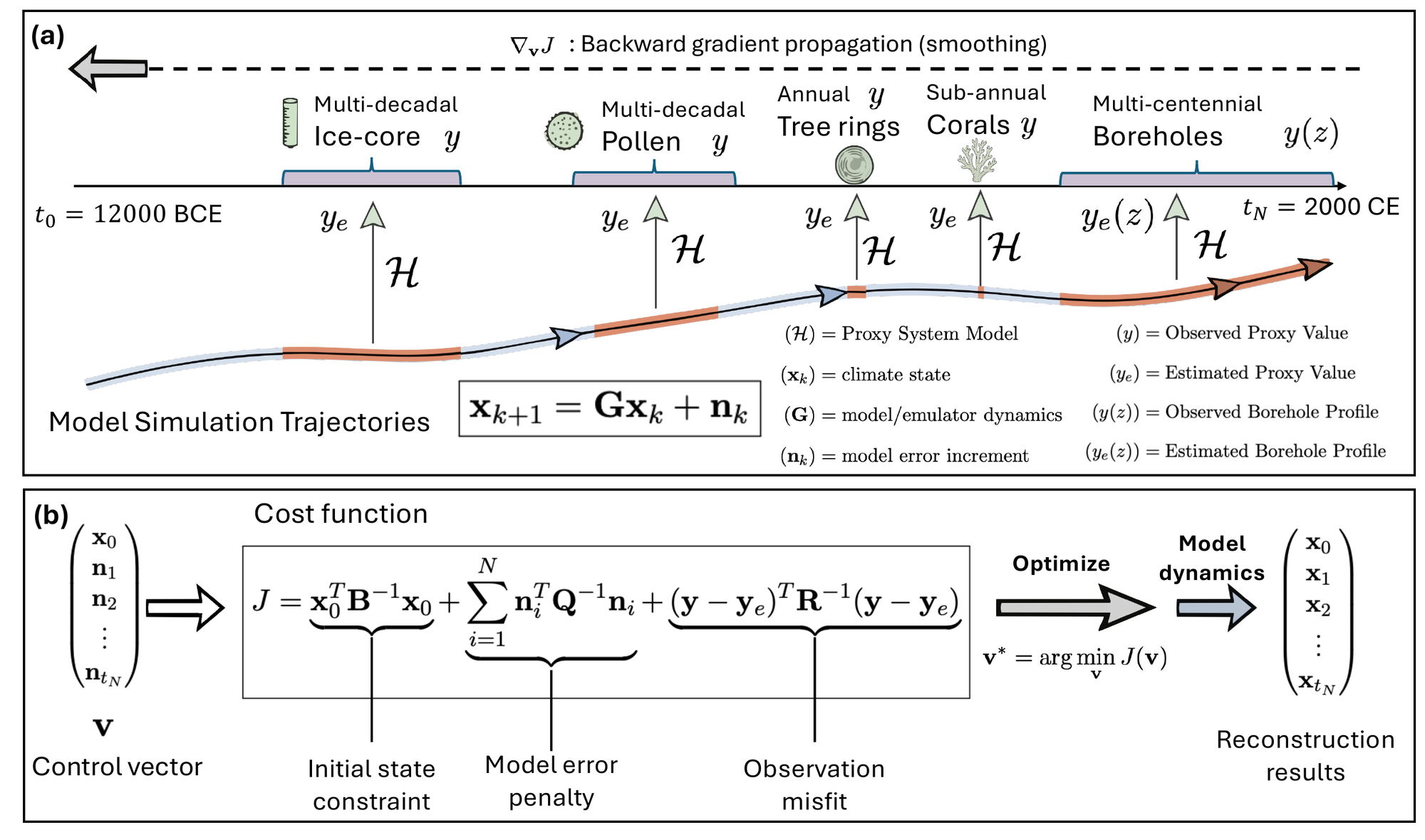
LMR4D-Var estimates the entire trajectory jointly using weak-constraint four-dimensional variational data assimilation. Observation operators preserve each archive’s seasonality, averaging interval, or physical memory. Later observations can revise earlier climate states through the coupled model.

Framework: preprint §§1–2. The main 500 BCE–2000 CE reconstruction and Holocene sensitivity experiments serve different purposes; the latter assess what the framework could support with a suitable emulator.

Evidence from the preprint

What a joint reconstruction reveals

Three results, with the figures
and the assumptions behind them.

01

Surface temperature and ocean heat evolve together.

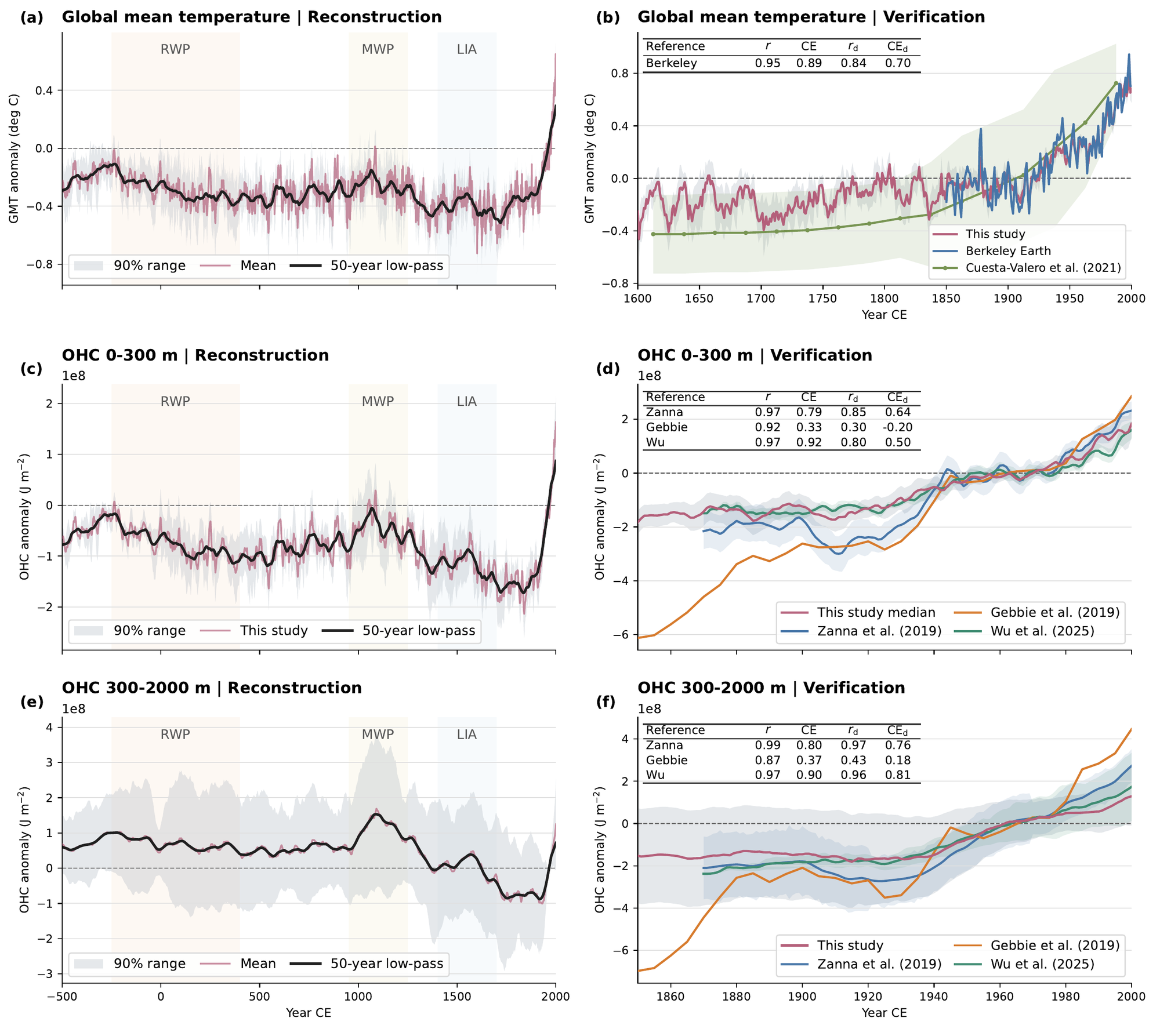
The main experiment combines PAGES2k, Temp12k, and boreholes to reconstruct global mean temperature and ocean heat content in two layers, 0–300 m and 300–2000 m, from 500 BCE to 2000 CE.

Annual global mean temperature agrees with Berkeley Earth over 1850–2000 CE (r = 0.95; CE = 0.89). After removing linear trends, agreement remains substantial (r = 0.84; CE = 0.70). Adding boreholes especially improves agreement with external estimates of the deeper layer.

Ocean heat content is inferred through the coupled dynamics and covariance, using proxies that primarily constrain surface climate. It is a demanding indirect diagnostic.

Preprint §3 · Figs. 3–4 · Table 1
Figure 3: reconstructed global mean temperature and ocean heat-content anomalies for 500 BCE–2000 CE, with instrumental and external comparisons for the 0–300-m and 300–2000-m ocean layers.
Fig. 3 · Climate history and external verification. Left: the reconstructed long record. Right: comparisons with Berkeley Earth and external temperature and ocean estimates. Rose curves are the five-prior mean; gray shading is the nominal 90% inter-model-emulator range.
02

Modern ocean warming stands out in this reconstructed history.

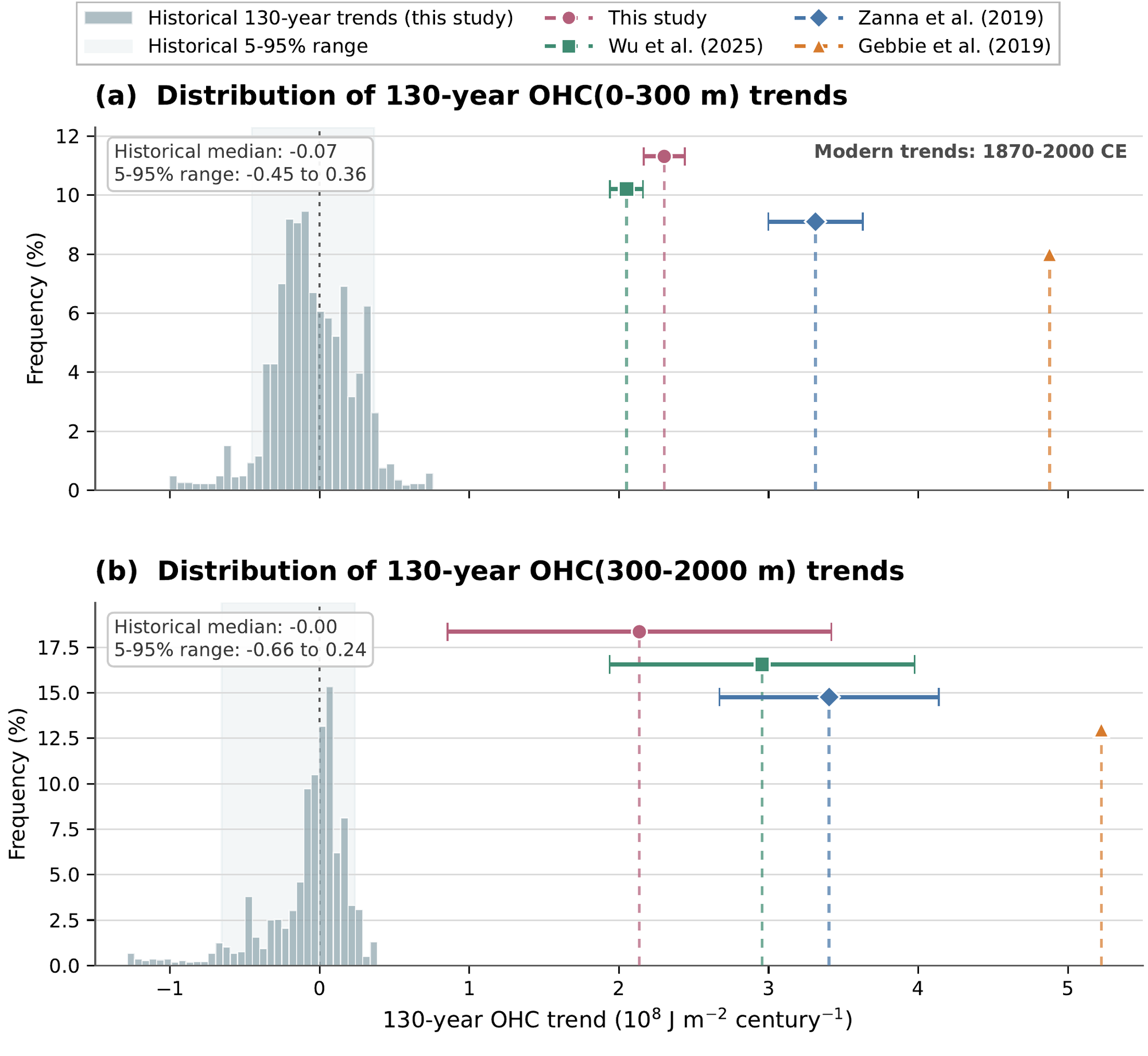
The 1870–2000 CE ocean heat-content trends exceed those in all 2,240 comparable historical windows within 500 BCE–1869 CE, in both ocean layers.

The comparison uses equally long 130-year intervals and the unfiltered annual median across five model-emulator-specific reconstructions. It places modern warming within the reconstructed historical distribution.

Multicentennial ocean heat-content amplitude remains uncertain: external estimates differ, and sparse surface-sensitive proxies constrain the subsurface ocean indirectly.

Preprint §3 · Fig. 5 · Fig. S6
Figure 5: reconstructed modern 130-year ocean heat-content trends compared with pre-1870 historical trend distributions in the 0–300-m and 300–2000-m layers.
Fig. 5 · Equal-duration ocean warming trends. Historical windows span 500 BCE–1869 CE; the modern interval is 1870–2000 CE. Results use the combined PAGES2k, borehole, and Temp12k experiment. These distributions describe the reconstruction under its model and proxy assumptions.
03

Longer records reveal the importance of the climate prior.

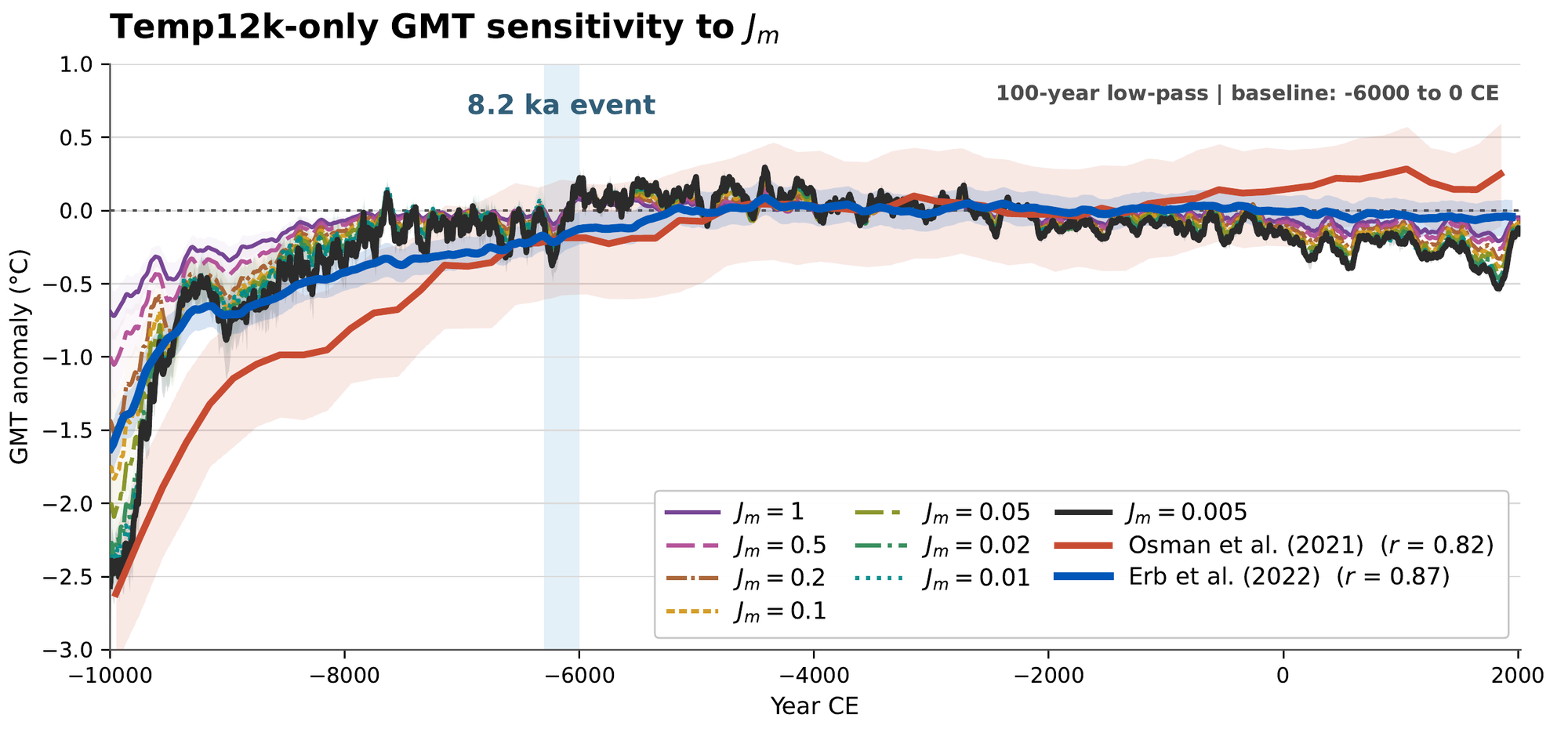
Temp12k-only experiments demonstrate assimilation of records averaged over decades to millennia over a Holocene-length seasonal trajectory.

The inferred history changes when the model-error weight changes. A strong last-millennium-trained prior can constrain long-term climate changes too tightly; allowing more model error gives low-frequency observations greater influence.

These are sensitivity experiments. Credible Holocene or deeper-time applications require emulators that represent the relevant orbital, ice-sheet, and other boundary-condition changes.

Preprint §§3–4 · Fig. 8
Figure 8: Temp12k-only Holocene global mean temperature sensitivity experiments with different model-error weights, compared with other temperature reconstructions.
Fig. 8 · Holocene sensitivity to model error. Temp12k-only reconstructions explore how the balance between an imperfect emulator and low-frequency proxy constraints affects the climate history. This is a test of the framework’s behavior over long windows.

How the system works

An entire trajectory.
Three sources of uncertainty.

01 / REPRESENT

A coupled seasonal state

A linear inverse model represents surface air temperature, sea-surface temperature, two ocean heat-content layers, and Northern Hemisphere sea ice concentration and thickness. Five model-specific priors test sensitivity to the coupled dynamics.

02 / CONNECT

Each archive keeps its timing

PAGES2k records constrain their calibrated seasons. Temp12k targets are evaluated over their averaging intervals. A heat-diffusion operator connects borehole temperatures to the surface-temperature history.

03 / OPTIMIZE

Fit the history jointly

The initial condition and model-error increments are optimized together. The objective balances uncertainty in the initial state, imperfect model evolution, and proxy observations across the full assimilation window.

Figure 1: a coupled climate emulator and archive-specific observation operators feed a weak-constraint 4D-Var objective balancing initial-state, model, and observation errors.
Fig. 1 · The multiscale weak-constraint 4D-Var framework. Observation operators act on the seasonal climate trajectory using the time footprint or physical memory of each archive. Source: preprint §2.

Verification at three levels

A pseudo-proxy experiment withholds the entire CESM-LME model family from the prior. Instrumental and external products test real-proxy results. Independent-proxy experiments withhold 20% of records from each archive family and repeat the test 20 times.

These tests answer different questions: recoverability in a controlled model, agreement with external estimates, and skill against unassimilated proxies. See preprint §2.4.

Joint optimization in motion. An illustrative 1000–2000 CE trajectory animation from the academic homepage. The main real-proxy reconstruction spans 500 BCE–2000 CE.

Paper, methods & resources

Start with the preprint.

Version 2 · 9 September 2026
Supporting information is included in the PDF

Which experiment answers which question?

Experiment labels used in the preprint
ExperimentRecords assimilatedPurpose
P2kPAGES2kBaseline with high-resolution proxies
P2k_BHPAGES2k + boreholesIsolate long-memory borehole information
P2k_T12kPAGES2k + Temp12kIsolate low-frequency temperature targets
P2k_BH_T12kAll three archive classesMain combined reconstruction and ocean-trend analysis
T12kTemp12k onlyHolocene sensitivity to model-error weighting

Source: §2.4 and supporting Table S3. Four seasonal analyses per year underlie the annual and lower-frequency diagnostics shown in the paper.

Research context & uptake

From seasonal filtering
to joint climate histories.

COMPANION WORK

LMR Seasonal

The earlier published framework carries coupled climate information forward using seasonal ensemble Kalman filtering. LMR4D-Var jointly revises an entire trajectory, allowing records with long averaging intervals or physical memory to constrain earlier states.

The preprint compares their global mean temperature skill in Table 1. LMR Seasonal paper and data citation ↗

INDEPENDENT RESEARCH USES

Citation evidence

This is a recent preprint. No independent study citing or using this particular framework was verified in the source review for this page. That describes the review result, rather than a total citation count.

Reviewed 4 October 2026. The citation guide below provides the verified reference for discussing the framework.

Scope & interpretation

What the reconstruction
can support.

Based on preprint §§2–4.

  • Preprint results. This page describes arXiv version 2; conclusions and resources may change during revision and publication.
  • Seasonal analysis does not give every proxy seasonal resolution. Time-averaged records retain their original temporal footprints and primarily constrain slower variability.
  • Ocean heat content is indirectly constrained. Most assimilated proxies record surface climate. Large-scale ocean evolution is supported by the coupled emulator and external comparisons; regional and depth-dependent patterns remain less certain.
  • Prior spread is incomplete uncertainty. The spread across five emulators describes model sensitivity. It does not exhaust uncertainties in proxy calibration, chronological age, observation errors, or model structure.
  • Holocene tests require careful interpretation. A last-millennium-trained linear emulator omits changes in orbital forcing, ice sheets, and other boundary conditions. The long-window experiments assess sensitivity and potential.
  • Sea ice is Northern Hemisphere only. The coupled state represents concentration and thickness there; it does not include Antarctic sea ice.

Reference & resources

Cite this work

Download BibTeX
DISCUSSING THE FRAMEWORK

Cite the preprint

Use Meng et al. (2026), arXiv:2608.19469, for the method and results. Identify v2 when referring to the figures and analyses described here.

USING PROXY RECORDS

Cite the source compilations

Also credit the original PAGES2k, Temp12k, or borehole products that you use. Their references and versions are documented in the preprint.

USING RECONSTRUCTION OUTPUTS

Record the exact version

If outputs or code are provided to you, cite the preprint and record the experiment, model prior, files, and code commit. Use a data or software DOI when an official archive becomes available.

Preprint · version 2

Meng, Z., G. J. Hakim, J. Emile-Geay, T. Gondhalekar, and E. J. Steig, 2026: Coupled multiscale paleoclimate reconstruction with four-dimensional variational data assimilation. arXiv preprint, arXiv:2608.19469v2. doi:10.48550/arXiv.2608.19469.

BibTeX · arXiv preprint
@misc{Meng2026LMR4DVar,
  author        = {Meng, Zilu and Hakim, Gregory J. and Emile-Geay, Julien
                   and Gondhalekar, Tanaya and Steig, Eric J.},
  title         = {Coupled multiscale paleoclimate reconstruction with
                   four-dimensional variational data assimilation},
  year          = {2026},
  eprint        = {2608.19469},
  archivePrefix = {arXiv},
  primaryClass  = {physics.ao-ph},
  doi           = {10.48550/arXiv.2608.19469},
  url           = {https://arxiv.org/abs/2608.19469v2},
  note          = {Preprint, version 2, 9 September 2026}
}

Figures and abstract come from Meng et al. (2026), arXiv v2, released under CC BY-NC-ND 4.0. The preprint PDF includes supporting information. Use the versioned preprint reference above for the results described on this page.